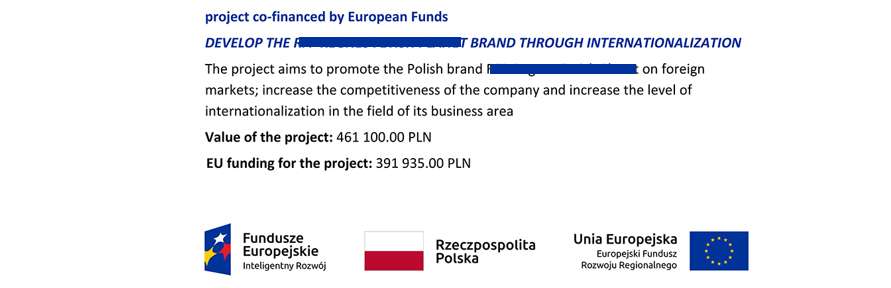
Currently, we are represented in the press with two very recent articles. We are financing our competition.
We discovered the note about European funding of nearly €110,000 on our competitor’s website (see image above). The goal of this funding is to strengthen our competitor’s position on the European market. Especially after the massive burdens of recent years — COVID measures, energy prices, supply chain disruptions, etc., which likely affected other countries as well — this is certainly a commendable effort. But is it fair? And does it support equitable competition?
The German Taxpayers’ Association states the following: EU funding policy at the expense of German businesses. How taxpayers are financing their own competition. The European Union officially pursues the goal of strengthening the competitiveness of the internal market. However, according to the Taxpayers’ Association of Saxony, a different picture is increasingly emerging: EU funding is being used to build up production capacities in other member states, while German businesses — which largely finance these funds — receive hardly comparable support.
A representative case from Saxony illustrates this
A representative case from Saxony illustrates this structural development. A traditional sewing workshop, founded in 1882 and family-run across five generations, was economically stable until 2019 and at times employed 19 people. As a result of state-imposed COVID measures, massive cost increases for energy, increasing bureaucracy, and disrupted supply chains, reserves had to be used and jobs were cut. Only through drastic measures was insolvency avoided so far.
After years of extraordinary pressure on small and medium-sized businesses, it is — from the perspective of the Taxpayers’ Association — no longer acceptable that domestic companies are largely left unsupported while foreign competitors are strengthened using contributions from German taxpayers.
Funding for competitors — not for domestic businesses
While other EU member states, particularly in Eastern Europe, specifically promote production capacities and brand development in the textile sector, comparable programs in Germany are scarce. The problem is particularly that these subsidies are financed by EU funds — and therefore also by German taxpayers.
Saxony as a structural development region — yet little support
Although Saxony continues to be classified as an EU structural development region, significant funds flow into infrastructure, administration, academic programs, or model projects. Traditional production businesses — especially labor-intensive industries such as the textile sector — rarely benefit from these programs.
Other EU countries use the same funding pools in a much more industry-oriented and economically practical way.
Not an isolated case: unequal funding across other industries
According to the Taxpayers’ Association of Saxony, this is by no means an isolated problem of the textile industry. Comparable distortions in funding can also be observed in food processing, mechanical and plant engineering, energy-intensive medium-sized companies, and craft industries with deep manufacturing value chains.
While these sectors are specifically stabilized or modernized in other EU member states, costs, regulations, and bureaucratic requirements are increasing in Germany. At the same time, funding flows into politically defined large-scale and model projects, whose benefits for regional value creation and employment are often questionable.
The Taxpayers’ Association of Saxony views this funding practice as a structural misallocation of public resources. If European competitiveness is taken seriously, it cannot be allowed that German taxpayers finance the dismantling of domestic production structures while simultaneously helping to build up foreign competition.
The Free Press reports positively: “Textile manufacturers in the Chemnitz region defy low-cost foreign competition.”
There are hardly any textile companies left in the Chemnitz region that can compete successfully. Not only are wages lower abroad, but funding opportunities are also better there. (…)